Reddybook
Exchange
The exchange is where Indian cricket bettors get better odds, bet against each other instead of the house, and trade live positions during IPL matches. This guide explains how it actually works — with real Rs. calculations and honest trading scenarios.
What Is the Reddybook Exchange — The Honest Explanation
Most people who start cricket betting use a standard sportsbook — you pick an outcome, accept the odds the platform offers, and wait for the result. The platform has built a margin into every price, which means the odds you see are always slightly lower than the true probability of that outcome. Over thousands of bets, that margin is how the platform makes its money.
The Reddybook Exchange works completely differently. Instead of betting against the platform, you are betting against other users. Reddybook sits in the middle, matching your bet with someone who wants to take the other side. The platform does not set the odds and does not build a margin into every price. Odds are set by supply and demand — by what users are willing to accept on both sides of each bet. The only thing Reddybook takes is a small commission (around 2%) on your net winnings — not a hidden margin baked into every price.
"A sportsbook offers you odds designed to guarantee the platform a profit on every market, regardless of who wins. An exchange offers you odds set by real people with real money. The difference, on a competitive IPL match, is typically 5 to 9 percent in your favour — and that adds up to thousands of rupees over a full cricket season."
This model is the same one used by the world's largest betting exchanges — established for decades in the UK and Europe. Reddybook brings it to India with a cricket-first focus, UPI payment integration, and WhatsApp-based onboarding that makes accessing the exchange as simple as any other part of the platform. Your existing Reddybook betting ID gives you full exchange access — no separate registration, no separate wallet, no separate deposit.
Why Exchange Odds Are Almost Always Better
The mathematical reason exchange odds beat sportsbook odds is straightforward. On a sportsbook, the combined implied probability of all outcomes in a market adds up to more than 100% — the excess is the platform's margin. On the Reddybook Exchange, the combined implied probability of all outcomes should theoretically sum to 100% (with minor bid-ask spread between back and lay prices). No margin means better odds for the person placing the bet.
In practice, for a closely contested IPL match where MI are slight favourites: a sportsbook might offer MI to win at 1.72 and CSK to win at 2.08. The combined implied probability of those two prices sums to roughly 106% — the 6% excess is the sportsbook's margin. On the Reddybook Exchange for the same match, MI might be available to back at 1.86 and CSK at 2.14. Those exchange prices give you Rs.140 more on a Rs.1,000 MI bet and Rs.60 more on a Rs.1,000 CSK bet — every single time you place a comparable bet on an exchange vs a sportsbook.
Back Betting and Lay Betting — What They Mean
The concept that confuses most new exchange users is lay betting. Back betting is intuitive — you back something to happen. Lay betting is the opposite — you bet that something will not happen. Understanding both is the key to using the Reddybook Exchange properly.
When you back an outcome, you are betting in the traditional sense — you stake money on something happening, and if it does, you receive your stake back plus profit. You are the one doing the backing, the other side of the market is laying against you.
🏏 EXAMPLE — BACKING MI
You back Mumbai Indians to win at odds of 1.86, staking Rs.1,000. If MI win, you receive Rs.1,860 (Rs.860 profit + Rs.1,000 stake back). If MI lose, you lose your Rs.1,000 stake.
When you lay an outcome, you become the bookmaker for someone else's back bet. You are saying "I think this will not happen" and accepting the risk that it does. Your profit is the backer's stake. Your loss if the event happens is the odds times the backer's stake, minus the stake itself.
🏏 EXAMPLE — LAYING MI
You lay Mumbai Indians at odds of 1.88. Someone backs Rs.1,000 against you. If MI lose, you keep their Rs.1,000. If MI win, you pay out Rs.880 (Rs.1,880 minus their Rs.1,000 stake).
The Key Thing New Exchange Users Miss
Lay betting does not mean you need to find one specific person to take your bet. The Reddybook Exchange matches you automatically with users who have placed back bets on that outcome. Your lay bet is filled by the existing back orders in the market. You do not need to arrange a private bet with another user — the exchange does all the matching automatically. Your only job is to decide the outcome you want to lay, the odds you are willing to accept, and the liability you are comfortable with.
Exchange vs Sportsbook — What the Difference Costs You
Saying "exchange odds are better" is not useful unless you can see exactly how much better, in rupees, on bets of the kind you actually place. Here are real comparisons from IPL 2026 matches — the same outcomes available simultaneously on the sportsbook and the Reddybook Exchange.
| Outcome | Sportsbook Odds | Exchange Back Odds | Extra Profit (Rs.1,000 bet) |
|---|---|---|---|
| MI to win (slight favourite) | 1.72 | 1.86 | +Rs.140 |
| CSK to win (slight underdog) | 2.08 | 2.14 | +Rs.60 |
| RCB powerplay session Over | 1.85 | 1.97 | +Rs.120 |
| MI to win during live chase (2.0 on SB) | 2.00 | 2.12 | +Rs.120 |
| India to win Test (heavy favourite) | 1.20 | 1.26 | +Rs.60 |
What This Means Across a Full IPL Season
What the Reddybook Exchange Looks Like
When you navigate to the Exchange section inside your Reddybook account, you see a different layout from the standard sportsbook. Each market shows two columns of prices — back odds in blue/green and lay odds in red/pink. The prices in each column represent what users are currently willing to accept on either side of that bet.
The numbers below each price show the amount of money currently available to be matched at that price — called the available liquidity. During a live IPL match, major markets like match winner and session runs have substantial liquidity, meaning your bet will typically be matched instantly at the displayed price. Smaller or more niche markets may have lower liquidity, which means you might need to accept a slightly different price or wait for your bet to be matched.
One Wallet, One Login
Your Reddybook Exchange balance is the same wallet as your sportsbook and casino balance. Winnings from exchange bets settle into the same wallet that you use for everything else on the platform. You do not need to move money between sections or maintain separate balances.

on every market
How to Trade Live on Reddybook Exchange During IPL
Live trading is the most powerful thing the Reddybook Exchange makes possible that no sportsbook can offer. You open a position before or during a match, and if the market moves in your favour, you close it for a guaranteed profit — regardless of the final result. Here are three real scenarios showing exactly how it works.
Pre-Match Back, Live Lay — Locking In Guaranteed Profit
The most common exchange trading strategy for IPL cricket
This is the scenario that most people have heard about but never seen explained with actual numbers. You identify a team you think is underpriced before the match. You back them at high odds. They bat first and score a big total. Their odds shorten dramatically in the chase market. You lay them at the shorter odds to guarantee profit whatever happens next.
With both positions open, here is what happens at the end of the match regardless of the result:
🏆 IF MI WIN THE CHASE
+Rs.1,200 from back bet — Rs.655 liability from lay bet
🏆 IF CSK WIN
−Rs.1,000 from back bet + Rs.1,419 from lay bet win
Result: you make money whether MI or CSK win the match. The exact amounts differ slightly because the odds moved, but the position is profitable on both outcomes. This is what exchange trading makes possible — a standard sportsbook only lets you bet one side and wait.
Using the Exchange to Get Better Odds on a Simple Match Winner Bet
The easiest exchange benefit — no trading required
You do not have to do complex trading to benefit from the Reddybook Exchange. The simplest use case is just placing a standard back bet — the same bet you would place on the sportsbook — but at the better exchange price and sitting on it until the match ends.
Rs.285 more on a single Rs.2,000 bet. No clever trading required — you just used the exchange instead of the sportsbook for an outcome you were going to bet on anyway. Multiply that across thirty or forty bets in an IPL season and the difference is significant.
Lay the Favourite, Collect if Anything Else Happens
When you are confident a favourite is overrated
This scenario is about lay betting specifically. You believe a team is being priced too short — the market has made them a bigger favourite than your cricket reading suggests they should be. On a sportsbook, you cannot act on this belief directly. On the Reddybook Exchange, you can lay them.
✓ IF MI LOSE (YOUR VIEW IS RIGHT)
You collect Rs.1,000 from the backer's stake
✗ IF MI WIN
You pay Rs.400 liability to the backer
Note that your liability is calculated before placing the lay bet and displayed in the bet slip. Always review your maximum liability before confirming a lay bet. The lower the odds you lay at, the lower your liability — which is why laying heavy favourites at short odds carries lower risk than laying outsiders at long odds.
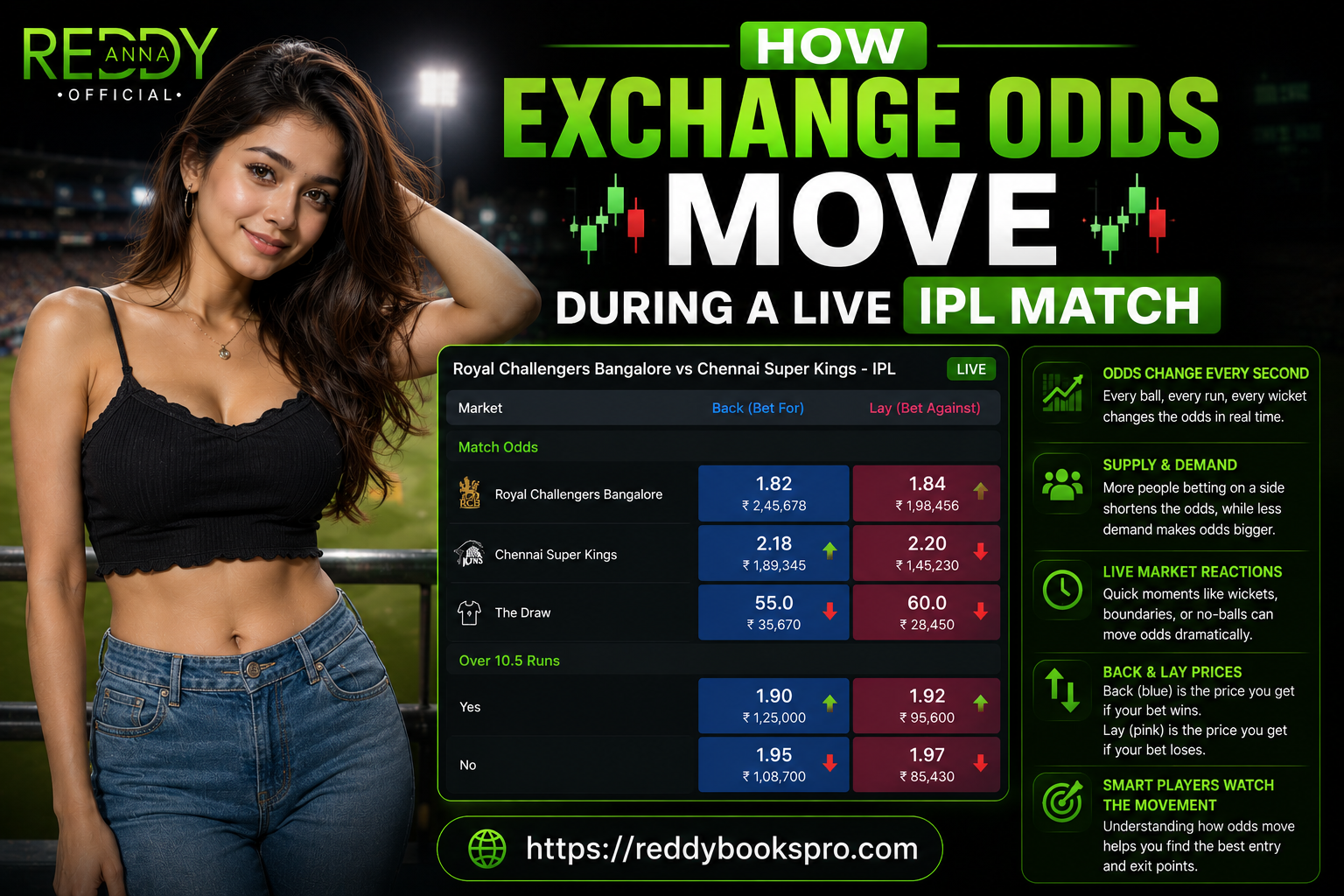
How Exchange Odds Move During a Live IPL Match
Exchange prices during a live IPL match are one of the most dynamic financial instruments you will encounter in Indian sports. They update after every few balls — sometimes every delivery — reflecting new information: a wicket falling, a boundary off a difficult ball, a bowler no-balling twice in an over, a batsman getting hit on the helmet and looking unsettled.
This constant movement is where exchange trading opportunities appear. A team that was at 1.90 before the toss might move to 1.60 after winning the toss and choosing to bat on a flat track. Then jump to 2.10 after losing two wickets in the powerplay. Then fall back to 1.45 after a 40-run partnership in overs 10 to 15. Each of those price movements is a potential trading window if you back the team before the fall in odds or lay them before the rise.
Reading Price Movement — What To Watch For
The most reliable price movement signal in IPL exchange betting is a wicket falling in a key partnership. When a team loses a set batsman who was anchoring the innings, exchange prices on that team shift immediately and often overreact briefly — making them momentarily better value than the new situation actually warrants. Experienced traders recognise this and use the brief overreaction window to open positions before prices stabilise at their correct level.
every few balls
How to Use the Reddybook Exchange — Step by Step
If you already have a Reddybook betting ID and funded wallet, you already have exchange access. Here is how to find and use it.
Log In and Find the Exchange Section
Log into your Reddybook account with your betting ID and password. From the main navigation, look for the Exchange tab — it is separate from the Sports or Sportsbook section. The Exchange shows a different layout from the standard betting interface, with both back and lay prices visible for every market.
Select a Market and Understand the Prices
Choose a sport and event — during IPL season, the match winner market for the evening's fixture is the most liquid and the best place to start. You will see back prices (green/blue column) and lay prices (red/pink column). Back prices are slightly lower than lay prices — the gap between them is the bid-ask spread, and it is how the market naturally organises itself without a bookmaker's intervention.
The number below each price is the available amount at that price. If Rs.30,000 is available at a back price of 1.86, up to Rs.30,000 worth of bets can be matched at that exact price right now.
Place Your Back Bet First — Start Simple
Click on the back price for the outcome you want to bet on. A bet slip opens. Enter your stake. The potential return is calculated automatically. Before confirming, read the potential return carefully — on the exchange, this is your total return including your original stake, not just the profit. Confirm the bet and it is placed.
If the price was available, your bet is matched immediately. If the liquidity was lower than your stake, part of your bet may be matched and part will sit in the market waiting to be matched. You can see your open and matched positions in the My Bets section.
Try Lay Betting Only After You Understand Liability
When you are ready to try lay betting, the most important thing to check before confirming is your liability — the maximum amount you will pay if the outcome you laid happens. This figure appears in the bet slip before you confirm. Your liability is not the same as your stake. It is calculated as: (lay odds − 1) × backer's stake. At odds of 1.40, laying Rs.1,000 means a Rs.400 liability. At odds of 3.00, laying Rs.1,000 means a Rs.2,000 liability. Always know this number before you confirm.
Monitor, Trade, or Hold to Settlement
Once your bet is placed, you have three options: hold it to settlement (simplest — just wait for the match to finish), cash out at current market price if the option is available, or open a counter position to lock in profit (the trading scenario described in the examples above). Winnings from settled exchange bets go directly into your Reddybook wallet, net of the ~2% commission on profits. You can withdraw or use them for further bets immediately.
When Exchange Betting Makes Sense — and When It Does Not
The exchange is the right tool for most IPL betting situations, but being honest about when it is and is not the best choice is more useful than simply saying it is always better.
✅ Use the Exchange When:
- You are placing bets on major IPL markets — match winner, main session runs — where exchange liquidity is high and your bet will be matched instantly at good prices
- You want to trade a live position — open before the match and close mid-innings to lock in profit regardless of the final result
- You want to lay the favourite — bet that a team will not win — which is only possible on the exchange, not on a standard sportsbook
- You are betting regularly across a full IPL season — the cumulative price advantage over a sportsbook adds up to thousands of rupees
- You want to compare market prices — exchange prices represent genuine user sentiment rather than bookmaker pricing, making them a useful reference even if you end up placing elsewhere
- You understand lay liability and have calculated your maximum exposure before placing any lay bets
✗ Be Careful With Exchange When:
- Placing bets on niche or low-profile markets — exchange liquidity may be thin, meaning you cannot get your full stake matched at the displayed price
- You have never placed a lay bet before and have not fully understood how liability is calculated — the risk is higher than standard betting if not properly understood
- You are placing very small stakes (under Rs.100) — the percentage advantage over a sportsbook is less significant at very low stakes and commission is taken on all net wins
- Looking for in-running positions on very fast-moving markets where prices change multiple times per over — prices can shift dramatically between clicking and confirmation
- You are new to betting entirely — start with sportsbook match winner bets to understand odds before adding the complexity of back/lay mechanics and live trading
- You are betting under emotional pressure or trying to recover losses — the exchange's flexibility can amplify poor decision-making as much as it can support good trading
The Risk All Exchange Guides Leave Out
Exchange trading creates conditions where a winning position can be reversed very quickly if the match goes the wrong way after you open a trade. Back-lay trading requires discipline about when to cut positions and accept a smaller loss — not holding a losing position and hoping the match swings back. The exchange's power to lock in profit works both ways: it also makes it easy to lock in a loss by holding too long. The best exchange bettors set position rules before the match starts and stick to them.
Reddybook Exchange — Honest Answers
What is the Reddybook Exchange?
What is the difference between back and lay on Reddybook Exchange?
Are Reddybook Exchange odds better than the sportsbook?
Can I trade live during IPL on Reddybook Exchange?
Do I need a separate account to use Reddybook Exchange?
What commission does Reddybook charge on exchange bets?
Is exchange betting harder than standard sportsbook betting?
Exchange Betting Comes With Real Financial Risk
The exchange's ability to lock in profit can make it seem like a low-risk activity. It is not. Every open exchange position carries full financial risk until it is closed or settled. Lay bets carry liability — the amount you could lose is often larger than the amount you could win. Live trading amplifies both gains and losses depending on when and how you act. Never bet more on the exchange than you are genuinely comfortable losing entirely.
18+ only. If betting causes financial stress, set deposit limits through WhatsApp support or request self-exclusion. The Vandrevala Foundation helpline (1860-2662-345) provides free, confidential support in India 24/7.
More Reddybook Guides
Ready to Use the Reddybook Exchange?
Your existing Reddybook ID already includes exchange access. If you do not have an account yet, register via WhatsApp in under 2 minutes — it is free. Deposit from Rs.100 via UPI and the exchange is open to you immediately. Back, lay, and trade live IPL cricket. 18+ only — please bet responsibly.